

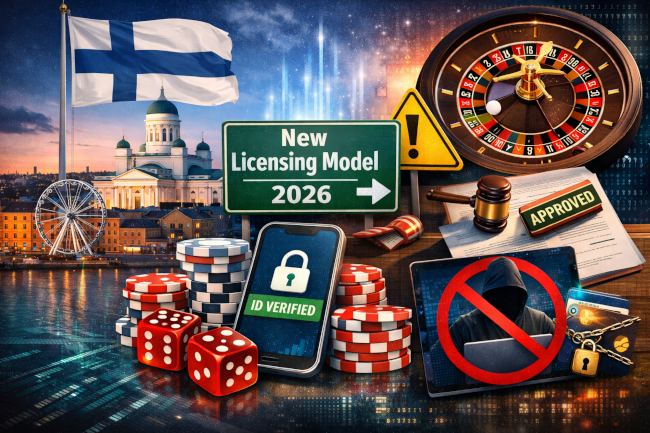
Finland’s casino story has long been written in one name, Veikkaus. You can still see that legacy in ordinary places where Finns actually gamble, not only in destination venues, but beside checkout lines and on phone screens during a dark winter commute. Gambling has been woven into the everyday, and that everyday proximity is exactly why the market is now being redesigned.
A cluster of modern trends is changing the Finnish casino environment, and they point in the same direction: more competition, more data, and tighter guardrails.
The monopoly-to-licence pivot
On 16 December 2025, Finland’s Parliament passed a new Gambling Act, the most significant rewrite in decades. The reform ends the long standing online monopoly and introduces a competitive licensing system, with the framework set to take full effect on 1 July 2027. Finland’s aim is to prevent and reduce gambling harm while improving the channelling rate, keeping players in a regulated, supervised offering rather than on offshore sites according to Intermin. The timeline is close. Licence applications open at the beginning of 2026, and licensed services can launch at the beginning of 2027.
Identity-first gambling
Finland is betting on identification as the foundation of player protection. Mandatory identity verification already shapes much of the market, and the new model reinforces verified play as the default for online gambling. This changes the user journey. “Instant play” becomes “access after verification,” a shift that makes it harder to drift into risky behavior unnoticed.
Responsible gambling as shared infrastructure
The reform pushes harm prevention from a brand feature into a system feature. A centralised self exclusion register is planned to cover licensed operators and Veikkaus, paired with mandatory deposit limits and the possibility of broader cross-operator limits. When protection tools work across the whole market, competitive advantage moves toward trust and retention, not just acquisition.
A marketing reset that bans the loudest tricks
Competition is coming, but Finland is not importing a marketing free-for-all. The new Act permits marketing only if it remains moderate, and it restricts channels and tactics, including a prohibition on influencer marketing. Expect more emphasis on brand trust and responsible messaging, and less on viral promotion. For those interested in the specifics of these changes, you can find more information about the new regulations at Gate to the Games Technik.
That posture is not theoretical. In September 2025, the government highlighted illegal gambling marketing in game streams and social media, underlining the attention regulators are paying to where young audiences spend time.
Enforcement via payment rails
Modern gambling enforcement is increasingly technical. Finland’s reform work includes the option of payment blocks against operators that operate or market illegally. Payment friction changes behavior quickly. If deposits fail or withdrawals feel uncertain, players tend to migrate to providers that “just work,” which is exactly what the regulated system is designed to offer.
The physical footprint is tightening as well
Finland’s electronic gambling machines have historically been visible in everyday retail settings. Policymakers have tested access restrictions, and research from Finland’s Competition and Consumer Authority has studied the effects of limiting access to these machines in a context where mandatory identification requirements have expanded for most land-based and all digital gambling. The trend line in Finnish online casinos is clear: less anonymous, impulsive play in public spaces, and more controlled access.
Data and AI shift from growth to compliance
Every serious operator personalises offers and tunes retention. Finland’s casino licensing model adds a second imperative: detect risk, intervene early, and document what you did. With identification, shared exclusion tools, and stricter marketing rules, the winners will be the brands that treat compliance as a product feature, not a legal afterthought.
Put these trends together and Finland’s casino future looks like a Nordic compromise in code: a competitive online market, built around verification, limits, and accountability. Finnish casino players will see more friction and fewer aggressive promos. Operators who want to win will need to deliver something simple and surprisingly hard: entertainment that can survive scrutiny.